
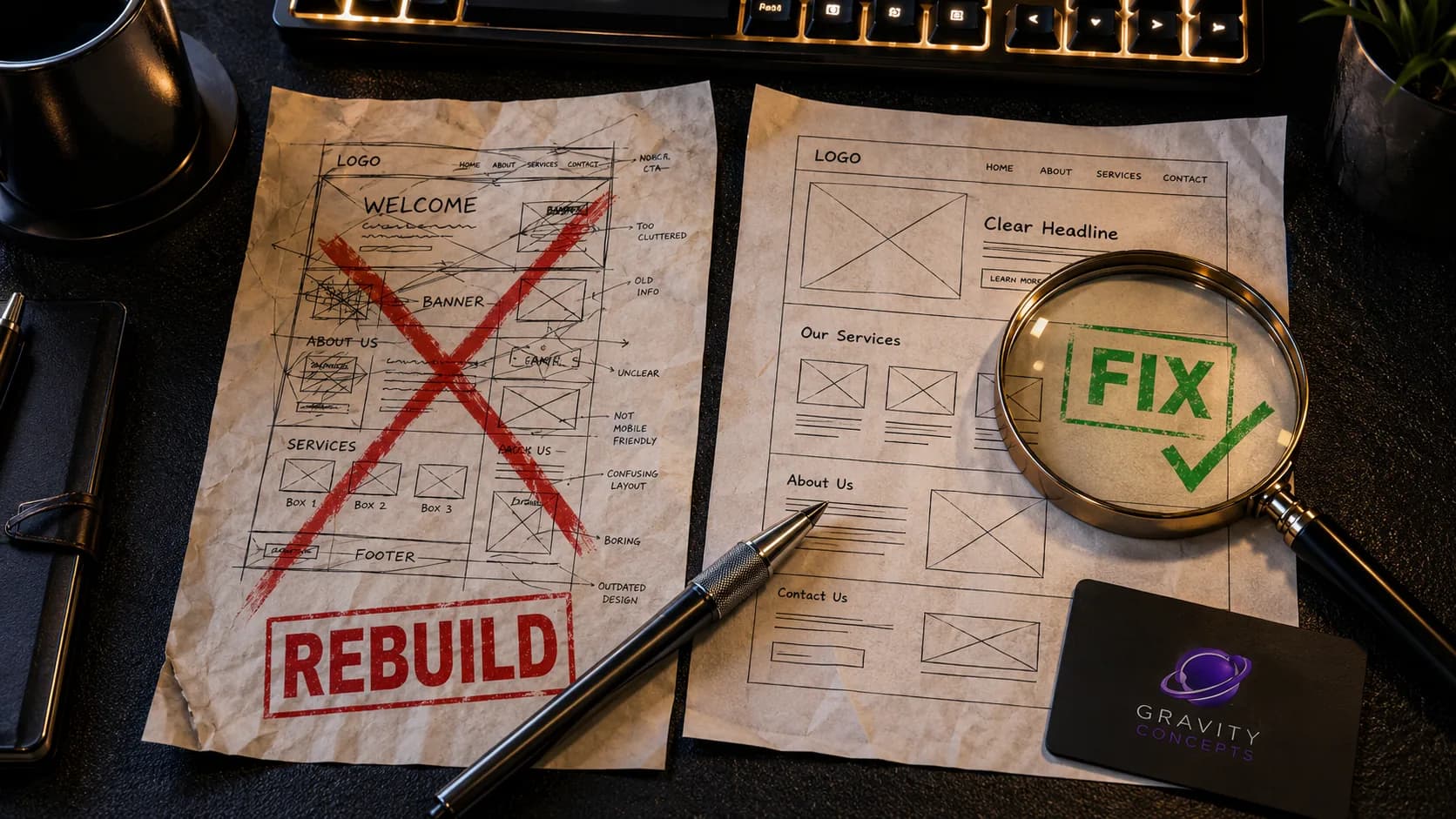
The question that decides the budget
Every business owner with a working but underperforming site eventually asks the same question: do I rebuild this from scratch, or can it be fixed?
The answer is rarely 'rebuild' and rarely 'fix.' It's one or the other, and getting it wrong in either direction wastes money. A rebuild that wasn't needed is expensive. A fix that can't solve the underlying problem is more expensive.
When a rebuild makes sense
A rebuild is the right call when the site's underlying structure — not its visuals — is the problem. Signs a rebuild is warranted:
- The site was built on a platform that can't scale: page builders, abandoned frameworks, or a CMS that's no longer supported.
- The message hierarchy is fundamentally wrong — there's no clear CTA, no coherent enquiry path, and restructuring the layout isn't enough to fix it.
- Speed issues are baked into the architecture — the framework or the hosting can't be optimized further without a rewrite.
- The site doesn't work on mobile at all. Not 'needs improvement' — doesn't work.
- Every fix takes three times longer than it should because the codebase has no documentation and the original developer is unreachable.
When a fix is the right call
A fix is the right call when the architecture is sound and the problems are surface-level. Signs a fix is enough:
- Speed issues can be solved with image optimization, caching, and a hosting upgrade — not a framework change.
- Structure issues can be solved with layout changes and copy rewrite — not a rebuild.
- Trust signals are missing but the underlying content is strong — you can add a portfolio section, testimonials, and a response-time promise without rebuilding.
- The mobile experience works but needs refinement — tap target sizing, form field font size, viewport fixes.
- The design feels dated but the architecture is sound — a visual refresh on a solid foundation is a fix, not a rebuild.
The pattern that costs the most money
The most expensive mistake is rebuilding the visual layer only. A new coat of paint on top of a broken structure just moves the problem. Six months later the owner is back where they started — with a prettier site that still doesn't convert.
The rebuild has to start with structure. The order that works: audit the existing site, define the message hierarchy, decide the enquiry path, then redesign and rebuild. If the redesign comes first, the rebuild is cosmetic.
The opposite mistake costs less but still hurts: fixing a site that needs a rebuild. Patching the same problem monthly because the underlying framework can't support the fixes. Every fix feels like progress; the site still doesn't convert; the owner eventually rebuilds anyway, having wasted the fix budget.
How to decide
Ask one question first: is the problem structural or surface-level? If structural — platform, message hierarchy, mobile architecture — a rebuild is the cheaper choice over two years. If surface-level — speed, trust signals, form behaviour, layout — a fix is the cheaper choice, and the rebuild can wait.
If you're not sure which you have, that's what an audit is for. Run the twenty-point audit first. If the site passes most checks, a fix is what's needed. If it fails most of them, a rebuild usually pays for itself within the first six months of running properly.
Frequently asked
Can I rebuild only part of my site?
Sometimes. If the architecture supports it, you can rebuild the homepage and the enquiry path while keeping the rest — but this only works if the underlying framework is sound. If the framework is the problem, partial rebuilds just delay the full one.
Is a redesign the same thing as a rebuild?
No. A redesign changes the visual layer. A rebuild changes the platform, structure, and message hierarchy. Redesigns on broken structures are the most common waste of money in this space.
How much does a rebuild typically cost?
At Gravity Concepts, a focused rebuild starts at ₦120,000 for a landing page or small multi-page site. Larger rebuilds — ecommerce, dashboards, custom integrations — move well beyond that. The published starting price is public on the services page.
How do I know if my current site can be fixed?
Run the twenty-point audit. If the site fails fewer than five checks, a fix is the right call. If it fails more than ten, a rebuild usually pays for itself faster than the cumulative cost of patching.
Ifeanyi Ejidike
Creative Director & Lead Engineer, Gravity Concepts
Writes from real client work — branding, print, and production-grade web builds for ambitious businesses.
Want us to handle this for you?
Design, print, web builds, and ongoing maintenance — fast response, direct communication.